Are Autonomous Fairway Mowers Worth It for Your Golf Course?
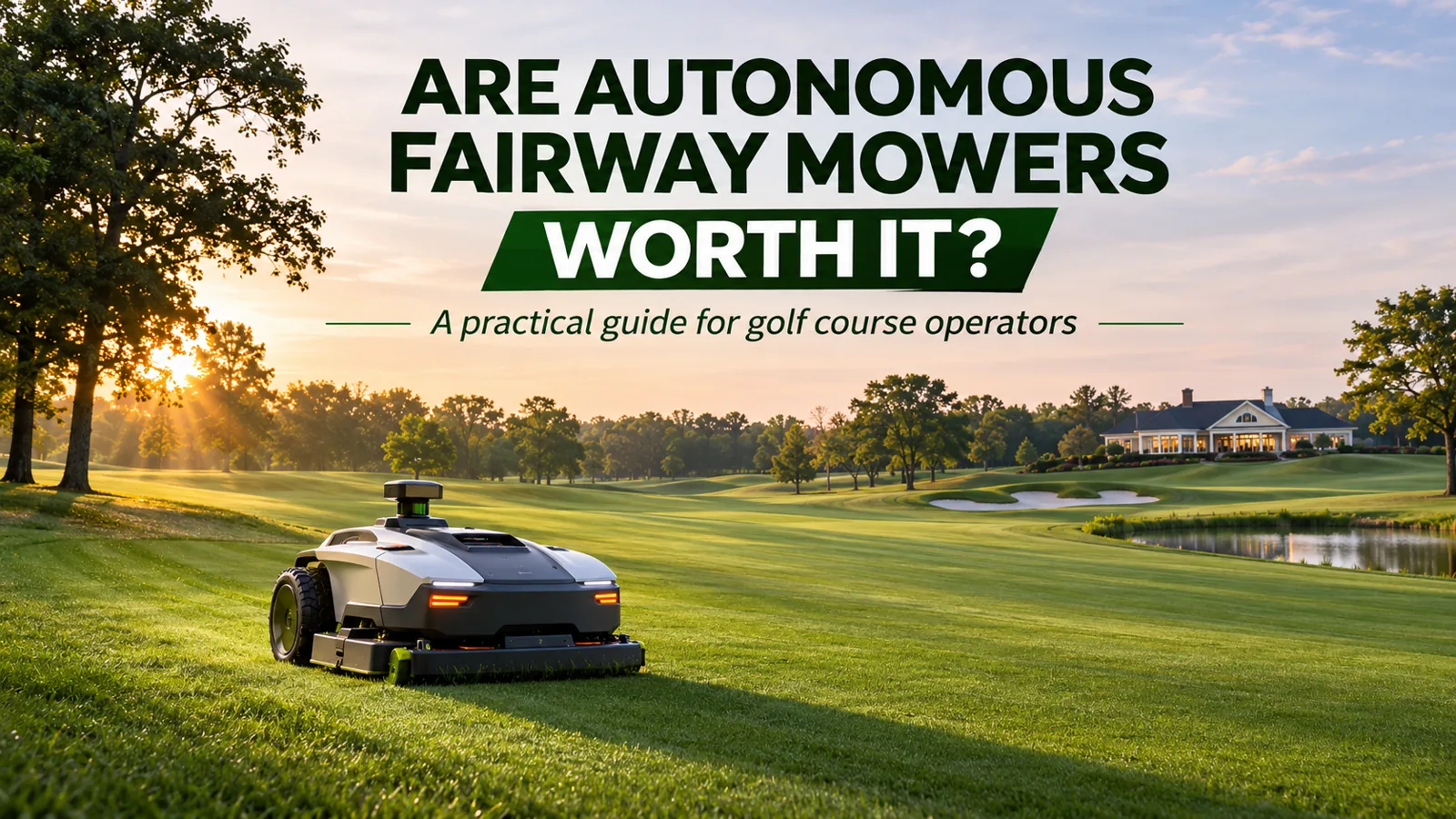
For most 18 hole courses in the US, an autonomous fairway mower is worth a pilot season right now, but not yet a full fleet swap. The machines do one job well: they cut open, gently sloped fairway at a steady height, often at night, without anyone in the seat.
They do not take people off your fairways so much as move their time somewhere else.
So the math only works if three things are true: your fairways suit the machine, you have a real plan for the hours it frees up, and someone on your crew owns the robot the way your equipment manager owns the reels. If you can say yes to all three, start with one machine on four to six holes for a full season, keep honest records, and let your own numbers make the call.
The rest of this guide explains how to reach that decision without relying on a sales demo. It is written mainly for superintendents and assistants, with a short section near the end for owners and general managers who need the bottom line.
Why is this question harder than it looks?
Most articles about robotic mowing ask whether the machines work. That is the wrong question in 2026. The better machines do work.
They hold a line, hit their mowing pattern within a couple of centimeters, and keep going while your crew sleeps. The harder question is whether the machine fits the way your course actually runs: your staffing, your irrigation schedule, your play, your terrain, and your budget cycle.
Two courses can buy the same unit and come to opposite conclusions. One course has wide, rolling fairways, a crew short three people every summer, and a mechanic who enjoys new technology.
The other has tight holes lined with trees, cart paths that cross fairways in six places, a night irrigation cycle that runs until 5 a.m., and a crew that is already fully staffed. The machine did not change between those two courses. The course did.
So instead of reviewing machines, this guide walks through the questions that decide whether autonomy makes sense for your property.
What is actually on the market in late 2026?
It helps to know that "autonomous golf mower" can mean a few different kinds of equipment. The kind more and more courses are testing is a fleet of smaller robots.
Fleets of smaller robotic mowers
This approach uses many smaller units, usually rotary, working the same area in parallel over longer periods. The best known example came from a European tour event in 2026, where the host course ran 16 small robots on its championship fairways, mowing overnight through a rainy week.
Several brands now sell or have announced compact robotic mowers, some about 24 inches wide, aimed at fairways, rough, and sports turf. A growing number of US courses are testing them.
These fleets work on a different idea. Instead of one machine doing a job fast, many machines do it slowly and almost constantly.
That can mean very frequent, light cuts, which some turf responds to well. It also means more units to keep charged, more units to update, and more units that can get stuck.
Not every trial goes well
Installs fail too. Some courses that test these machines have described an install that the vendor and the course ended up pulling out before it went into service, while a separate trial with a different brand went ahead on a few fairways.
That is a normal story in new technology. It is also a good reason to treat any first unit as an experiment, not a commitment.
What savings are courses actually seeing?
Courses getting real value from autonomous fairway mowers are saving in a few clear places: operator hours, overtime, fuel, and wear on equipment. How big those savings get depends more on how the course uses the freed time than on the machine itself.
The courses reporting the best results treat the machine as a way to protect their margins in a tight labor market, not as a way to cut corners on conditions.
Operator hours and overtime. The biggest saving is the time a person used to spend driving fairway mowers. You will not get all of it back, because someone still checks the machine, clears debris, handles alerts, and keeps it clean and charged, so measure that supervision time during your pilot. The saving is strongest at courses that cannot fill seasonal positions, where it shows up as less overtime and fewer jobs left undone during the summer rush.
Fuel and engine upkeep. Fully electric units take gas out of the fairway program, along with oil changes, filters, and other engine work. Hybrids reduce this work but do not remove it.
Longer machine life. One maker of electric autonomous mowers says its machines can last up to three times as long as a gas powered mower. Treat that as the maker's claim, and ask any vendor for service life records from courses that have run the machine for several years.
Better use of a skilled crew. When fairways get mowed overnight, your best people spend the morning on bunkers, hand watering, edges, and detail work. That does not show up as cash, but it shows up in course conditions, and conditions are what keep members and rounds coming back.
Payback when positions are reduced. A superintendent who wrote publicly about these machines in 2026 estimated that a course adding two units and reducing two positions could see the investment pay for itself in about three to four years. Courses that keep their staff and move the hours to other work see the return mostly as higher quality rather than cash.
How to measure your own savings
Keep it simple. Before the machine arrives and all through your pilot, track weekly operator hours on fairways, overtime hours, fuel use, engine and reel maintenance time, and the work your crew finished with the freed hours.
Compare those numbers season to season. Your own records will tell you more than any figure from another course, and they are what your owner will want to see.
What changes on the turf?
A reel is a reel, but the way an autonomous machine uses it differs from how your operators do. A few things tend to change.
Mowing frequency
Because the machine does not get tired and does not cost overtime, many courses start mowing fairways more often. More frequent mowing with smaller clippings can tighten up turf and improve consistency.
It can also mean more wear in turnaround areas if patterns are not varied. Rotate patterns the same way you would with a human operator, and watch the turn zones carefully in summer.
Night mowing and dew
Many courses run these machines overnight so they finish before play. The European tour event mentioned earlier did exactly that.
Night mowing means mowing in dew, and wet turf behaves differently. Clippings clump and can sit on the surface in lines. You may need a morning pass with a dew whip or blower, which takes back some of the time you saved.
Some superintendents shift mowing to the early evening, before dew sets in, and accept that it will overlap with late play on some holes. Test both on your own course.
Disease pressure
Mowing wet turf at night can spread certain diseases from plant to plant, the same way any equipment can. This is not a reason to avoid the technology.
It is a reason to watch your fungicide program and scouting notes closely during the first humid stretch. If you see disease tracking along mowing lines, change your timing.
Edges, collars, and cleanup
Autonomous machines are very good in the middle of a fairway and more cautious near the edges. Depending on how your no go zones are set, there may be a strip along bunkers, collars, and approaches that needs a cleanup pass.
Measure this during your pilot. A machine that does most of a fairway can still leave you with a daily cleanup job that eats into the savings.
Striping and presentation
If your members care about a classic striped look, ask to see the machine's patterns in person. Most can produce clean stripes, and the larger units let you choose different turn styles.
But some presentation details that an experienced operator handles by feel, like adjusting a line to frame a hole, have to be set in software. Your best operator should help design the patterns, not just watch.
Is your course a good fit for autonomous mowing?
Walk your property with these questions in mind. Each "no" is not a dealbreaker, but each one adds work or limits what the machine can do.
Are your fairways open and gently sloped? Every machine has slope limits. Steep banks, mounding, and sharp drops near greens may need to be marked off.
Ask the vendor for the exact slope limit, then walk your fairways with a digital level. Many courses find that some holes are great candidates and some are not.
How much tree cover is there? RTK GPS needs a clear view of the sky, and heavy canopy can weaken the signal. Machines that combine GPS with cameras and other sensors handle this better. Ask to see the unit work on your toughest hole, not just your easiest one.
How do machines get from hole to hole? If the machine has to cross cart paths, roads, bridges, or areas the public walks through, ask how it does that safely and whether it can do it alone.
Some early systems needed a person to drive the mower to the first fairway. Newer ones move between areas on their own, but your layout decides how practical that is.
What is near the fairways? Water, steep drops, homes, roads, and maintenance areas all need clear no go boundaries. Courses inside housing developments need to think hard about residents walking dogs or kids playing on the course at night.
What does your irrigation schedule look like? This deserves its own section.
How do night mowing and irrigation fit together?
This is the issue that surprises the most people, and almost no one writes about it. Most US courses irrigate at night. Most autonomous fairway programs also mow at night. Those two jobs are fighting over the same hours on the same ground.
Mowing right after irrigation means mowing soft, wet turf. That can cause scalping, tire marks, and clumped clippings. Irrigating right after mowing is usually fine.
So in many cases, the answer is to mow first, then water. That only works if your irrigation window can be shortened or shifted, and in a hot, dry July it may not be possible.
Courses handle this in a few ways:
- Split the night: the robot mows a set of holes early in the evening, and irrigation follows on those holes later.
- Run irrigation in zones and let the robot work behind the heads as each zone finishes and drains.
- Mow only part of the course each night and rotate.
- Keep night mowing for spring and fall, and move to early morning mowing in peak summer.
None of these is complicated, but all of them require your irrigation tech and whoever runs the robot to sit down together and build a schedule. If your vendor's demo did not raise this issue, raise it yourself.
Also check how the machine handles irrigation heads, valve boxes, and drainage covers. Most machines are fine with flush heads, but a head that sticks up after a repair, or a valve box lid that has been knocked loose, can damage reels. Your morning check should include a quick look for these.
How do you run a pilot that actually tells you something?
A pilot that ends with "it seemed fine" is a wasted season. Here is how to set one up so it produces a decision.

Pick the right holes
Choose four to six fairways that represent your course, not just your easiest holes. Include at least one with tree cover, one with a cart path crossing, and one with your typical slopes.
If the machine does well only on your three flattest holes, you need to know that before you buy a second unit.
Record a baseline first
Before the machine arrives, record how fairway mowing runs today on those holes. Track operator hours per week, fuel, reel maintenance time, and any cleanup passes.
If you can, take photos from fixed points on each fairway every two weeks, and note clipping volume and turf color. Without a baseline, you will end up comparing the robot to your memory, and memory is generous.
Track the right things during the pilot
Keep a simple weekly log. Use this as your checklist:
- Hours the machine mowed and acres covered
- Hours your staff spent supervising, moving, cleaning, and fixing it
- Number of stops or alerts, and what caused them
- Cleanup time on edges and collars
- Any turf issues, such as scalping, disease, or wear
- What your crew did with the hours that were freed up
That last item is the one most courses forget, and it is the one your owner will ask about.
Run it long enough
A two week demo shows you how the machine looks. A full season shows you how it lives.
Try to cover spring green up, summer stress, and fall, so you see it in wet, dry, hot, and cool conditions, and so your staff gets past the learning curve. Most vendors offer some form of trial, lease, or subscription that makes a full season pilot possible. Ask for it.
Decide with your numbers
At the end of the season, go back to your weekly log and compare it with your baseline, hole by hole.
Then answer one question: if you had the money back, would you buy the same thing again? If yes, plan the next unit. If no, write down why. Either way, you have something solid to show your owner.
What should you ask any vendor before you sign?
Bring these to your next demo. A good vendor will answer them directly. A vague answer tells you something too.
- What is the exact slope limit, and how does the machine behave when it reaches it?
- How does it handle loss of GPS signal under trees or loss of cell connection?
- Can it move between holes by itself on our layout, or will someone need to move it?
- What does the service plan include, and what happens to the machine if the plan ends?
- Can it be operated manually if the autonomy system fails?
- Who does service in our area, and how fast can they be on site?
- Is a loaner available during repairs?
- Who updates the maps when we change a tee, a bunker, or a fairway line, and does that cost extra?
- What is the expected battery life, and how are batteries replaced?
- Can we speak with two superintendents who have run this machine for at least a full season, and who you did not pick for us?
The last question is the most useful one on the list. Call those references and ask what they wish they had known before buying.
Should you choose a hybrid or a fully electric mower?
It is tempting to think fully electric and fully autonomous is always the better choice. Often it is. Electric machines are quieter, have fewer moving parts, and remove fuel handling from your shop.
But a hybrid with a seat and steering wheel gives you something valuable during the transition: a fallback. If the autonomy has a bad week, if a software update has a problem, or if you need to mow a fairway at 6 a.m. before an event, someone can climb on and drive it.
For a course buying its first and only autonomous unit, that fallback may be worth more than the extra benefits of going fully electric. For a course building a fleet, where one unit being down is less of a problem, fully electric may make more sense. There is no single right answer, but it is a choice you should make on purpose.
What is the bottom line for owners and general managers?
If you skipped to this section, here is what you need to know.
It pays off in one of two ways. Either it lets you run with fewer people on fairways, which saves cash, or it frees your current crew to do work that improves the course, which raises quality. Your superintendent should tell you which goal comes first before you buy, and how they will measure it.
It works best on open, gently sloped fairways, at courses that struggle to hire enough staff, with a specific person on the crew responsible for running it.
The smart first step is a pilot season on a handful of holes, with a written baseline and a weekly log. Ask your superintendent for that plan, and ask to see the numbers at the end of the season. That is a small, clear decision with very little risk, and it will tell you far more than any demo.
Frequently asked questions
Can it mow greens or tees?
The machines discussed here are mainly used on fairways. Greens need a much lower height of cut and much more precise handling, and most courses still mow them by hand or with walk behind and triplex units. Some smaller robots are used on rough and surrounds, but check each product's specs.
Is it safe to run at night with no one around?
The machines include obstacle sensors and remote shutoff, and many courses run them overnight. You still need a written plan for who responds to alerts, how you keep people off active holes, and what happens with wildlife.
How long does setup take?
It depends on the size of your course and the product. Expect several days of mapping and testing with the vendor before the machine runs on its own, plus a learning period for your staff after that.
Product details in this guide reflect public information as of November 2026. Always confirm current specifications with your dealer.